
Bike game
Stunt Game
(Android APK file)
Or scan the QR code:
A market is a place or venue that facilitates the exchange of goods and services. Markets can be physical or virtual.
A market is any place or venue where buyers and sellers can exchange goods and services. A market may be physical, like a retail outlet, or virtual, like an online brokerage with no physical contact between buyers and sellers.
Some key characteristics of a market are the availability of an arena, buyers and sellers, and a commodity or other asset that can be bought and sold.
Candra Huff / Investopedia
A market is anyplace where two or more parties can meet to engage in an economic transaction—even those that don’t involve legal tender. A market transaction may include goods, services, information, currency, or any combination that passes from one party to another. In short, markets are any setting where buyers and sellers can gather and interact.
Every trade needs at least two parties: a buyer and a seller. In some cases, a third party is required to introduce competition and balance the market. As such, a market in a state of perfect competition, among other things, is characterized by a high number of active buyers and sellers.
Beyond this broad definition, there are many types of markets, depending on what is being sold. For instance, it may refer to the stock market, which is the place where securities are traded. It may also describe a collection of people who wish to buy a specific product or service in a particular place, such as the Brooklyn housing market; it could also refer to an industry or business sector, such as the global diamond market.
Certain decisions that help shape the market are determined by an economic system known as the market economy. In this system, factors like investments and the production, distribution, and pricing of goods and services are led by supply and demand from businesses and individuals. As such, a market economy is unplanned and is not part of a planned or command economy, where the government dictates all of these factors. Examples of market economies include the United States, Canada, the United Kingdom, and Japan.
The Securities and Exchange Commission (SEC) regulates the stock and bond markets in the United States. It puts provisions in place to prevent fraud while ensuring traders and investors have the right information to make the most informed decisions possible.
Whatever the context, a market establishes the prices for goods and other services. These rates are determined by supply and demand. The idea of supply and demand is one of the very basics of economics. The sellers create supply, while buyers generate demand.
Markets try to find some balance in price when supply and demand are in balance. But that balance can be disrupted by factors other than price, including incomes, expectations, technology, the cost of production, and the number of buyers and sellers participating.
Simply put, the number of goods and services available is determined by what people want and how eager they are to buy. Sellers increase production when buyers demand more goods and services. Producers tend to raise their prices when demand increases. When buyer demand decreases, they drop their prices and, therefore, the number of goods and services they bring to market.
Markets may be represented by physical locations where transactions are made. These include retail stores and similar businesses that sell individual items to wholesale markets selling goods to distributors. Or they may be virtual. Internet-based stores and auction sites such as Amazon and eBay are examples of markets where transactions can occur entirely online, and the parties involved never physically connect.
Markets may emerge organically or as a means of enabling ownership rights over goods, services, and information. When on a national or more specific regional level, markets may often be categorized as developed or developing. This distinction depends on many factors, including income levels and the nation or region’s openness to foreign trade.
The size of a market is determined by the number of buyers and sellers and the amount of money that changes hands each year.
Certain features help define a market and are necessary for it to function. The following are the most basic characteristics that shape a market:
Other features include competition, pricing, and the freedom to buy and sell goods and services.
Markets vary widely for several reasons, including the kinds of products sold, location, duration, and size. The constituency of the customer base, size, legality, and other factors are equally influential. Aside from the two most common markets—physical and virtual—there are other kinds of markets where parties can gather to execute their transactions.
An underground or black market refers to an illegal market where transactions occur without the knowledge of the government or other regulatory agencies. Many illegal markets exist to circumvent existing tax laws. This is why many involve cash-only transactions or non-traceable forms of currency, making them harder to track.
Many illegal markets exist in economically developing countries with planned or command economies, where the government controls the production and distribution of goods and services. When there is a shortage of specific goods and services in the economy, members of the illegal market step in and fill the void.
Illegal markets can also exist in developed economies. These shadow markets, as they’re also known, become prevalent when prices control the sale of specific products or services, especially when demand is high. Ticket scalping is one example of an illegal or shadow market. When demand for concert or theater tickets is high, scalpers will step in, buy a bunch, and sell them at inflated prices on the underground market.
The term “market” doesn’t need to refer to a specific place or venue. It can also be used abstractly to describe the changing availability of something in demand—for example, the jobs market or the housing market.
An auction market brings many people together for the sale and purchase of specific lots of goods. The buyers or bidders try to top each other for the purchase price. The items for sale go to the highest bidder.
The most common auction markets involve livestock, foreclosed homes, and art and antiques. Many operate online now. For example, the U.S. Treasury sells its bonds, notes, and bills via regular auctions.1
The blanket term “financial market” refers to anyplace where securities, currencies, and bonds are traded between two parties. These markets are the basis of capitalist societies, providing capital formation and liquidity for businesses. They can be physical or virtual.
The financial market includes stock exchanges such as the New York Stock Exchange (NYSE), Nasdaq, the London Stock Exchange (LSE), and the TMX Group. Other financial markets include the bond and foreign exchange markets, where people trade currencies.
Other than underground markets, most markets are subject to rules and regulations set by a governing body that determines the market’s nature. This may be the case when the regulation is as wide-reaching and widely recognized as an international trade agreement or as local and temporary as a pop-up street market where vendors maintain order and rules among themselves.
Almost everyone will interact with markets in at least two important ways.
First, as consumers, we typically buy items of value through some kind of market, whether a commercial supermarket, informal street markets, or a virtual marketplace like Amazon.
In addition, if you work a job, you are participating in the labor market. Just like other goods, the price of your labor (or salary) is set by supply and demand, although it is also regulated by the government. When you buy or rent a home, you are participating in the housing market, and if you choose to save part of your income in a 401(k) retirement plan, it will be invested in the stock and bond markets.
Markets are arenas in which buyers and sellers can gather and interact. A high number of active buyers and sellers characterizes a market in a state of perfect competition. The market establishes the prices for goods and other services. These rates are determined by supply and demand. The sellers create supply, while buyers generate demand. Markets try to find some balance in price when supply and demand are in balance.
A black market refers to an illegal exchange or marketplace where transactions occur without the knowledge or oversight of officials or regulatory agencies. They tend to spring up when there is a shortage of specific goods and services in an economy or when supply and prices are state-controlled. Transactions tend to be undocumented and cash-only, all the better to be untraceable.
Most markets are subject to rules and regulations set by a regional or governing body that determines the market’s nature. They can be international, national, or local authorities.
Markets are an important part of the economy. They allow a space where governments, businesses, and individuals can buy and sell their goods and services. But that’s not all. They help determine the pricing of goods and services and inject much-needed liquidity into the economy.
By offering a place to conduct transactions, markets allow entities access to the capital to further their interests, whether to fund infrastructure, fulfill growth plans, make purchases, or invest their money. This helps fuel innovation to secure a competitive edge in the marketplace.
How you structure a business determines your taxes, personal liability, day-to-day operations, and fundraising. Here are the 10 most common types of business.
by
Michael Keenan
Updated on Sep 24, 2024
ON THIS PAGE
10 types of business structures
How to choose the right business structure
Determining which type of business is right for you
Types of business FAQ
Start your online business today.
For free.
Start for free
Your business type is no mere administrative detail. How you structure a business determines things like corporate and personal taxes, your exposure to legal risks, your day-to-day operations, and your long-term growth plans. Ask yourself questions about how you see your business in both the near and distant future. Are you risk averse? Does a version of success as you see it involve selling your business? Do you want to be a publicly traded company?
The type of business you choose to register will also impact your financial liability for any business debts. If you apply for investment or funding, your business type will again affect your options.
Given the ramifications of your chosen business structure, and the 10 different types available for your small business, you likely have questions. Here’s a breakdown to help you decide which business structure is right for you.
10 types of business structures
Sole proprietorship
General partnership
Limited partnership
Limited liability partnership (LLP)
C corporation
S corporation
Benefit corporation
Limited liability company (LLC)
Nonprofit
Joint venture
The way you organize your business depends on whether you are acting alone or with partners, how much personal liability you’re willing to accept, whether you need to issue shares, and the types of licenses and insurance your business needs. Here are 10 types of business structures to consider:
1. Sole proprietorship
A sole proprietorship is an unincorporated business entity owned and operated by a single individual. Its main advantage lies in its simplicity: sole proprietorship is the default business entity designation for anyone selling a service or product themselves. A sole proprietorship requires no special filing. In addition, sole proprietors have complete control over their companies and enjoy a single round of taxation on personal income.
Nevertheless, the ease of setting up a sole proprietorship is a double-edged sword, because this business type offers the lowest protection for owners. As a sole proprietor, you are fully liable for your company’s financial and legal situation, which is legally riskier when compared to an LLC.
This means that if your business falls on hard times, your personal assets may be drawn on to settle business debts.
💡 Shopify’s suite of tools can help sole proprietors manage their orders, inventory, taxes, marketing, and more.
2. General partnership
General partnerships (GPs) are the default form of business partnerships, or businesses owned by two or more people.
Like sole proprietorships, general partnerships are subject to pass-through taxation, meaning they are only taxed once, at the partners’ personal income levels. In addition, general partners are equal participants in the firm, meaning everyone has a say in how the business operates.
However, general partnerships are vulnerable to some of the same drawbacks as sole proprietorships. Because there is no legal distinction between the general partners and the partnership itself, all owners are subject to unlimited liability for the company’s debts and damages.
Creditors and lawsuit plaintiffs can reach partners’ personal assets, and general partners are liable for the business conduct of all other partners—so choose your co-founders wisely.
3. Limited partnership
Similar to general partnerships, two or more people own limited partnerships (LPs) and enjoy pass-through taxation. The key difference between LPs and GPs is the existence of limited partners, people have limited liability for the business according to the amount of capital they’ve invested.
💡 All limited partnerships must have at least one general partner, who is subject to unlimited liability.
4. Limited liability partnership (LLP)
The final type of partnership, limited liability partnerships (LLPs), are owned by two or more partners who enjoy pass-through taxation. While partners in an LLP are liable for their own conduct, they are not personally liable for the conduct of other partners or the debts and damages of the business.
An LLP business structure provides additional separation between personal and company assets. Unfortunately, however, LLP status is not available to all types of businesses; it’s exclusive to certain licensed professions, such as law or accounting.
5. C corporation
C corporations, or C corps, are among the most common types of corporations and the ideal ownership structure for a large company. A C corporation is a legal entity completely separate from its owners, offering the strongest personal liability protection.
Another advantage of forming your small business as a C corporation is the relative ease of fundraising. C corps can be funded by issuing shares of stock. You can issue as many shares as you like and offer both common stock and preferred stock types.
One drawback of C corporations compared to other types of businesses is that each C corporation is a complex business organization requiring a detailed filing and registration process, as well as oversight via the drafting of bylaws and appointment of a board of directors.
Above all, the main downside of forming a C Corp is that you will not enjoy pass-through taxation status. That means C corporations pay income tax twice: once on corporate income and again on the personal income of owners and shareholders.
💡 C corporations can design bespoke commerce solutions for their business needs with Shopify.
6. S corporation
S corporations, or S corps, sidestep the double taxation issue that C corps face. Like partnerships, S corps are pass-through entities, which means that instead of paying corporate income tax as a business entity, they are taxed only once at the owners’ and shareholders’ personal income levels. Choosing between an S corp or LLC is a common decision for business owners.
That advantage is offset by limits on fundraising and strict requirements for maintaining S corp status. For instance, S corps may only issue common stock to a maximum of 100 shareholders, and those shareholders must be individuals who are citizens or permanent residents of the United States.
7. Benefit corporation
A benefit corporation, sometimes called a B corp, is a different type of for-profit corporation recognized by most US states. While they’re taxed the same way as C corps, benefit corporations place added emphasis on making a positive impact on local communities and the environment.
While a benefit corporation can both do good and generate profits, it’s subject to the same requirements as C corporations. Plus, a benefit corporation must demonstrate its commitment to a higher calling by publishing an annual report assessing its social and environmental performance.
8. Limited liability company (LLC)
Limited liability companies (LLCs) meld many of the characteristics of a partnership with those of a traditional corporate legal entity. LLCs are distinct legal entities, which helps to protect owners from personal liability for any debts and damages accrued by the business.
An additional advantage of forming your small business as a limited liability company is tax flexibility. LLCs can opt to be taxed as corporations (twice) or as pass-through entities like sole proprietorships and S corps.
The downside of forming a limited liability company is that the registration process is more complex than with sole proprietorship or partnerships. For instance, an LLC must write and file articles of incorporation and appoint a registered agent.
9. Nonprofit
A nonprofit is a business that has been granted tax-exempt status by the US Internal Revenue Service (IRS) on the basis that it advances a social cause benefiting the public. In essence, nonprofit refers primarily to a business’s tax status, as most nonprofits are also corporations.
The main advantage of forming your small business as a nonprofit is the tax benefit; if your organization qualifies as a 501(c)(3) tax-exempt organization under the Internal Revenue Code, it won’t have to pay federal income tax.
Nevertheless, nonprofits are limited in the business activities they can pursue and must reinvest all profits into the business.
10. Joint venture
A joint venture is essentially a partnership between one or more separate business entities. In these types of business arrangements, firms agree to pool resources toward the achievement of a specific task—often on a temporary basis.
Businesses might undertake joint ventures to win a contract, purchase real estate, or respond to changing industry regulations.
The upside of joint ventures as a business structure is that they allow participants to benefit from the resources of other participating firms without forfeiting independence by merging them into one organization. The main disadvantage, however, is that each participant is responsible for all the costs and losses of the joint venture.
Helpful resources:
Small Business Grants: Where To Get Funding in 2024
How To Start a Business
How to choose the right business structure
Assess your risk tolerance
Understand tax implications
Evaluate control and management needs
Consider funding options
Consider future growth and scalability
Set personal and business goals
1. Assess your risk tolerance
When figuring out your risk tolerance, think about how comfortable you are with potential financial and legal risks. Some key points to consider:
How important is it to keep your personal belongings separate from your business?
What’s the likelihood of your business facing legal challenges?
Are you OK with taking on business debt, or does that make you nervous?
Imagine you’re starting an online store selling custom-printed t-shirts. Your risk level might seem low at first glance, but there are still factors to consider. What if a shirt’s design infringes on someone’s copyright? Or what if the dyes cause allergic reactions in some customers?
If you aim to become the next big thing in online fashion, you might be willing to take on more risk to expand faster. But if you’re looking to run a modest side hustle, a more conservative approach might be better.
💡Note: There’s no “correct” level of risk tolerance. It’s about understanding your comfort level and choosing a structure that aligns with your business model. If you’re unsure, consulting with a business adviser or lawyer is always a good idea.
2. Understand tax implications
Different types of businesses qualify for different tax treatment by the IRS, as well as state and local tax authorities.
Business tax statuses include:
Pass-through tax status. Taxes are “passed through” from a company to its shareholders, who pay personal income tax on dividends.
Corporation tax status. Corporations are taxed twice: once on corporate income and again on shareholders’ personal income.
Nonprofit tax status. Nonprofits are exempt from some taxes at federal and state levels so long as they meet eligibility requirements.
Take the stress out of sales tax with Shopify Tax
With Shopify Tax, you can oversee your current sales tax obligations from Shopify admin, collect the right amount at checkout with product and location-specific accuracy, and let Shopify automatically apply rate and regulatory changes whenever they happen.
Explore Shopify Tax
3. Evaluate control and management needs
When picking your business structure, consider how much control you want over decisions and day-to-day operations. Different structures give you different levels of say in running things.
A sole proprietorship is good if you want total control. You’ll call all the shots, but you’ll also be on the hook for everything.
Partnerships split control between you and your partners. Make sure you trust them and agree on who does what.
Corporations have more complex management. There’s a board of directors, officers, and shareholders involved. You might have less direct control, but it can benefit bigger operations.
LLCs offer flexibility. You can run it yourself or set it up like a corporation with managers.
Think about your comfort level with sharing control. Do you work well with others or prefer to be the boss? How hands-on do you want to be in daily business operations? If you plan to grow big, a structure that allows for easier expansion might be smart.
4. Consider funding options
When you’re starting out, one key thing to think about is how you’ll fund your business. How you fund your business will dictate the business structure you choose.
Say you’re launching a new app. If you go the sole proprietorship route, you might be dipping into your savings or asking your family for a loan. It’s simple, but it might limit your options down the road.
On the flip side, forming a corporation could open doors to bigger possibilities. You could end up pitching to venture capitalists or even going public someday. A partnership lets you pool your resources with friends or colleagues.
Take some time to consider how different structures might affect your funding options. And when in doubt, consult a professional business adviser or lawyer on which option is best for your funding plans.
5. Consider future growth and scalability
When picking a business structure, think about where you want your company to be in five or 10 years. Different structures have pros and cons for growing your business:
Sole proprietorship. Easy to start but tough to expand. You’re on your own for funding and decision-making.
Partnership. This lets you team up with others, but growth can get messy as more partners join.
Limited liability company (LLC). Flexible and protects your personal assets. It’s good for small to medium-sized businesses that want room to grow.
Corporation. Best for big growth plans. Getting investors and going public is easier, but it comes with more rules and paperwork.
Think about:
How big do you want to get?
Will you need outside investors?
Do you plan to sell the business someday?
Pick a structure that won’t hold you back as your business takes off. Remember, you can always change your structure later, but getting it right from the start is easier.
6. Set personal and business goals
Ask yourself where you see this business going. Are you hoping to:
Grow it into a major company? If you want to grow beyond yourself, you may want to consider forming an LLC or C corporation.
Keep it as a side hustle? If you want a small, manageable business, you might fare well as a sole proprietor.
Eventually sell it? If you want to sell your company someday, consider staying a sole proprietorship. Since the business is owned by a single individual, there are no complex ownership transfers involved; you simply sell the business assets as the new owner directly.
You’re not locked into your choice forever. As your goals change (and they will), you can always restructure your business. The important thing is to pick a structure that aligns with your current plans and helps you work toward your goals, whether that’s becoming the next soda pop mogul or just earning some extra cash with a small home-based business.
Free: Business Plan Template
Business planning is often used to secure funding, but plenty of business owners find writing a plan valuable, even if they never work with an investor. That’s why we put together a free business plan template to help you get started.
Get the template now
Determining which type of business is right for you
Determining the right structure for your small business is one of the most important decisions you will make as an entrepreneur.
After reflecting on the questions above, consult a business attorney or certified public accountant (CPA). These professionals can give you personalized advice based on your situation and help you navigate any financial or legal implications.
Read more
Small Business Grants: Where To Get Funding in 2024
How To Start a Business in Vermont: 8 Easy Steps
What Is Exporting? Exporting Definition and Trends
How To Start an LLC in Ohio in 11 Simple Steps
How To Start an LLC in Nebraska in 11 Steps
How To Start an LLC in California in 12 Steps (2024)
General Partnership vs. Limited Partnership: What’s the Difference?
How To Choose the Best Domain Name in 2024 (7 Tips and Tools)
Sole Proprietorship vs. LLC: Which Is Best for Your Business?
Types of business FAQ
What are the 4 main types of businesses?
The four main types of businesses are sole proprietorship, partnerships, limited liability companies, and corporations.
What are the 10 types of business?
Sole proprietorship
General partnership
Limited partnership
Limited liability partnership (LLP)
C corporation
S corporation
Benefit corporation
Limited liability company (LLC)
Nonprofit
Joint venture
What are business categories?
Business categories are classifications that group similar types of businesses based on their activities or industries. These categories help organize businesses into regulatory, tax, and statistical categories, and include sectors like retail, manufacturing, health care, and technology.
What is the best business structure for a small business?
There is no one-size-fits-all “best” business structure for small businesses, as the ideal choice depends on liability protection, taxation, ownership structure, and growth plans. However, an LLC is generally considered the best structure for small- and medium-sized businesses.
Do I need a lawyer to set up my business?
While it’s not always legally required, consulting with a lawyer when setting up your business is highly recommended—especially for more complex structures like corporations or LLCs.
Reference: https://www.shopify.com/blog/types-businesses
A business entity is an organization that uses economic resources to provide goods or services to customers in exchange for money or other goods and services. Business organizations come in different types and in different forms of ownership.
The three major types of businesses (as to product offered) are:
A service type business provides intangible products (products with no physical form). Service type firms offer skills, labor, expertise, and other similar work in return for professional or talent fees.
Examples of service businesses are:
This type of business buys products at wholesale price and sells the same at retail price. They are known as "buy and sell" or "reseller" businesses. They make profit by selling their goods at prices higher than their purchase costs.
A merchandising business buys a product and sells it without changing its form. Examples include all distribution and retail stores such as: department store, grocery, hardware, clothes and accessories shop, consumer electronics, home furniture, appliance stores, drug stores, etc.
Unlike a merchandising business, a manufacturing business buys products with the intention of using them as raw materials to make a new product. Thus, there is transformation of the products purchased.
A manufacturing business combines raw materials, labor, and overhead costs in its production process. The goods produced are then be sold to customers. Examples include:
Many companies engage in more than one type of business, typically segregated through different departments or divisions.
Take for example a tech company that produces phones (manufacturing), sells them through their distribution centers (merchandising), and provides repairs and maintenance (service). A restaurant combines ingredients in making a meal (manufacturing), sells a cold bottle of beer (merchandising), and provides a dining venue (service).
These are the basic forms of business ownership:
A sole proprietorship is a business owned by only one person. It is easy to set-up and is the least costly among all forms of ownership. The owner faces unlimited liability; meaning, the creditors of the business may go after the personal assets of the owner if the business cannot pay them. The sole proprietorship form is usually adopted by small business entities.
Advantages of sole proprietorship:
Disadvantages of sole proprietorship:
A partnership is owned by two or more persons who contribute capital to conduct business. The partners divide the profits of the business among themselves based on agreed terms.
In general partnerships, all partners are have unlimited liability. In limited partnership (or Limited Liability Partnership, LLC), at least one partner is a limited partner. The creditors cannot go after personal assets of limited partners.
Advantages of partnership:
Disadvantages of partnership:
A corporation is a business organization that has a separate legal personality from its owners. Ownership in a stock corporation is represented by shares of stock.
The owners, known as stockholders, enjoy limited liability but have limited involvement in the company's operations. The board of directors elected from the stockholders, controls the activities and direction of the corporation.
Advantages of corporation:
Disadvantages of corporation:
In addition to these basic forms of business ownership, these are some other types of organizations that are common today:
A cooperative is a business organization owned by a group of individuals and is operated for their mutual benefit. The persons making up the group are called members. Cooperatives may be incorporated or unincorporated. Some examples of cooperatives are: utility cooperatives (water and electricity), cooperative banking, credit unions, and housing cooperatives.
Limited liability companies (LLCs) in the USA, are hybrid forms of business that have characteristics of both a corporation and a partnership or sole proprietorship. An LLC is easier to establish. It is not incorporated; hence, it is not considered a corporation. However, the owner/s enjoy limited liability like in a corporation.
An LLC may choose to be taxed like a sole proprietorship or partnership (flow-through taxation, where the company is not taxed and income is only taxed in the owners' tax returns) or like a corporation. By default, an LLC is taxed through flow-through taxation.
An "S Corporation" is not really a type or form of business entity, rather it is a tax classification in the US. This classification allows income to pass-through to the owners like in a partnership. In effect, the business is not taxed; instead, taxes are charged in the tax returns of the owners. In contrast, a "C Corporation" is a business that is taxed separately from its owners.
Main types of businesses:
• Service - intangible productsBasic forms of business organizations:
• Sole proprietorship - owned and controlled by only one personOther forms that also exist are: LLCs and cooperatives.
There are different types of businesses to choose from when forming a company, each with its own legal structure and rules. Typically, there are four main types of businesses: Sole Proprietorships, Partnerships, Limited Liability Companies (LLC), and Corporations. Before creating a business, entrepreneurs should carefully consider which type of business structure is best suited to their enterprise.
This article will provide a quick overview of these four basic types of businesses to help entrepreneurs make one of their most important decisions.
Corporate Finance Institute offers financial analyst training that you can apply to manage the financials of your business. Check out our Financial Modeling & Valuation Analyst (FMVA)® certification program!

A sole proprietorship is an unincorporated company that is owned by one individual only. While it is the most simple of the types of businesses, it also offers the least amount of financial and legal protection for the owner. Unlike partnerships or corporations, sole proprietorships do not create a separate legal identity for the business. Essentially, the owner of the business shares the same identity as the company. Therefore, the owner is fully liable for any and all liabilities incurred by the company.
An entrepreneur may choose this option if they want to retain full control of the company. Additionally, it is a relatively easy and inexpensive process to establish a sole proprietorship. There are also tax benefits, as income is considered the owner’s personal income and therefore only taxed once. Finally, there are relatively few regulation requirements for sole proprietorships.
As the name states, a partnership is a business owned by two or more people, known as partners. Like sole proprietorships, partnerships are able to take advantage of flow-through taxation. This means that the income is treated as the owners’ incomes so it is only taxed once. Owners in partnerships are responsible for the liabilities of the firm. However, there are some nuances to this. There are different types of partnerships: general partnerships, limited partnerships, and limited liability partnerships.
General Partnerships: This is the easiest type of partnership to form, with few upkeep costs. Every partner is considered as participating in the operations of the business, and there is unlimited liability for every partner. This means that every partner’s personal assets can be used to repay the liabilities of the partnership. This also means that each partner is responsible for every other partner’s actions.
For example, John and Dave are in a general partnership. If John is sued for malpractice, Dave’s personal assets may also be claimed against in the lawsuit.
Limited Partnerships: This type of partnership has at least one general partner. This general partner takes on unlimited liability for the partnership and manages the operations of the company. Additionally, there are also limited partners in limited partnerships. Limited partners only take on as much liability as their financial stake in the business. However, as limited partners, they are not involved in management decisions and do not have any direct control over the company.
Limited Liability Partnerships (LLP): LLPs are similar to general partnerships, where multiple partners are each responsible for the operations of the business. However, partners in LLPs are not personally responsible for the actions of other partners or the debts of the business. Unfortunately, not all businesses can be LLPs. This type of business is often restricted to certain professions, such as lawyers or accountants.
In general, as compared to other types of businesses, partnerships offer more flexibility but also have greater exposure to risk.
Limited liability companies (LLCs) are one of the most flexible types of businesses. LLCs combine aspects of both partnerships and corporations. They retain the tax benefits of sole proprietorships and the limited liability of corporations. LLCs are able to choose between different tax treatments. As long as the LLC chooses not to be treated as a C corporation, it retains its flow-through taxation status.
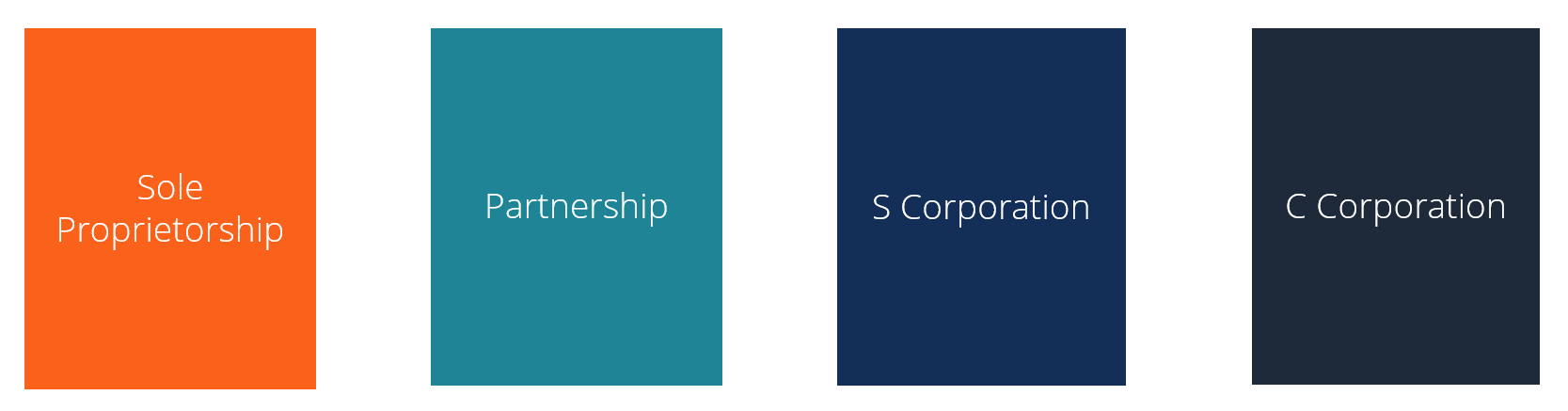
Additionally, LLCs benefit from limited liability status. In LLCs, the company exists as its own legal entity. This protects the owners of the LLCs from being personally liable for the operations and debts of the business.
Corporations are a separate legal entity created by shareholders. Incorporating a business protects owners from being personally liable for the company’s debts or legal disputes. A corporation is more complicated to create, as compared to the other three types of businesses. Articles of incorporation must be drafted, which include information such as the number of shares to be issued, the name and location of the business, and the purpose of the business.
In sole proprietorships and partnerships, if one of the owners passes away or declares bankruptcy, the company is dissolved. Corporations exist as a legally separate entity. Therefore, they are protected from this situation and will continue to exist even if the owner of the business passes away.
There are three main types of corporations:
C Corporation: This is the most common form of incorporation. The corporation is taxed as a business entity and owners receive profits that are then also taxed individually.
S Corporation: This is similar to a C corporation but may only consist of up to 100 shareholders. S corporations are pass-through entities like partnerships, so profits are not taxed twice.
Non-Profit Corporation: Often used by charitable organizations, non-profit corporations are tax exempt. All forms of incoming cash flow must be utilized to spend on the organization’s operations or future plans.
Thinking of starting a company? Corporate Finance Institute’s corporate strategy course teaches tactics and strategies in running a successful business!
Many businesses begin as sole proprietorships, as this type of business is great for many new, small businesses. As they grow and expand, many businesses tend to convert to corporations. eBay is a very famous example of a sole proprietorship that eventually converted into a corporation.
Hewlett-Packard (HP) is an example of an incredibly successful and famous partnership. Like eBay, as they grew, they eventually incorporated in 1947. However, the company began as a business partnership between two friends.
Chrysler is one of the largest automobile manufacturers in the United States. Since its inception, Chrysler has maintained its status as a limited liability corporation (LLC).
Finally, among the most famous of companies is Apple. Like most large companies that are listed on stock exchanges, Apple, otherwise known as Apple Inc., was incorporated soon after the company began its operations. To this day, Apple remains one of the largest companies in the world. It has continued to exist despite one of its co-founders, Steve Jobs, passing away.
Proper financial management is the backbone of any business. CFI offers resources that will help you expand your knowledge, advance your career, and manage the financials of your company, as well as your personal financials. Check out the CFI resources below to learn more:
Learn accounting fundamentals and how to read financial statements with CFI’s online accounting classes.
These courses will give you the confidence to perform world-class financial analyst work. Start now!
Boost your confidence and master accounting skills effortlessly with CFI’s expert-led courses! Choose CFI for unparalleled industry expertise and hands-on learning that prepares you for real-world success.


:max_bytes(150000):strip_icc():format(webp)/Market_Final-ffc28532c0de498499ba6e5e985645b9.jpg)
